
How AI Is Cutting Transcript Review Time from Weeks to Minutes
Admissions teams don't struggle with decisions; they struggle with the time it takes to get there. The decision itself is rarely the hard part. What slows everything down is everything that has to happen before that moment of judgment: the parsing, the manual entry, the cross-referencing, the flagging, the waiting. By the time a file is ready to evaluate, hours, sometimes days have already been spent just getting it to that point. The decision is ready. The paperwork isn't.
Every transcript that arrives carries its own variability; a different format, a different grading scale, a different set of course codes that need to be mapped against institutional rules before they mean anything actionable. Multiply that by thousands of applications in a cycle, and the math becomes punishing. The bottleneck isn't a lack of effort or expertise; it's the sheer volume of fragmented, inconsistent data that must be manually interpreted before a single evaluation can begin.
The cost of that fragmentation isn't just operational; it's competitive. Institutions that take weeks to respond are slowly ceding ground to those that move faster. Students don't wait for the best offer. They often accept the first clear one.
Now imagine a different approach: transcripts parsed and structured the moment they arrive, evaluations run automatically against your own rules and articulation agreements, and a clean, decision-ready file handed to your team, not a pile of raw data, but a recommendation waiting for a human sign-off.
This new approach isn't just about speed. It's about rethinking how institutions compete for students in an enrollment landscape that no longer waits. The institutions winning yield today aren't necessarily the most prestigious; they're the most responsive.
The Hidden Cost of the Transcript Bottleneck
Anyone who has spent time in an admissions or records office knows the reality. A freshman application might carry a weighted GPA that needs recalculating. A transfer transcript might arrive as scanned documents from multiple institutions, each using course codes that only make sense to the school that issued them. A dual-enrollment student's credits might be split across a high school and a community college, documented differently in both.
Before your team can evaluate a single applicant, every document must be read, interpreted, and manually cross-referenced, line by line, spreadsheet by spreadsheet, often against articulation tables that are complex. Multiply across thousands of applications per cycle, and the scale of the problem becomes clear.
The result is a bottleneck that grows heavier the busier things get. Staff burn out. Reviews slow down. And quietly, something far more costly begins to happen; students disengage. They don't complain. They simply accept the offer from the institution that got back to them sooner. Enrollment managers call this "melt", and it happens gradually, invisibly, while your team is still working through the pile.
Here's the hard truth: in enrollment management, time isn't just a metric, it's yield. Every week of silence sends an unintended message; we don't value your time, and that's a message no institution can afford.
Replace Weeks of Uncertainty with Immediate Clarity
A faster timeline doesn't just save time; it changes the entire experience for everyone involved.
For students, it replaces weeks of uncertainty with immediate clarity. A freshman no longer has to wonder if their dual-enrollment courses will count. A transfer student doesn't have to guess how many credits they're bringing with them. They get real answers, at the moment they need them the most, and that kind of transparency builds trust before a student even sets foot on campus.
For admissions and registrar teams, speed doesn't mean shortcuts. It means freedom. Freedom from the hours spent on manual data entry, outdated spreadsheets, and growing review queues. When the administrative weight is lifted, your team can focus on what they were actually hired to do, advise students, recruit talent, and handle complex cases that genuinely need human judgment.
And that's the most important point. This isn't about replacing expertise; it's about protecting it. Academic evaluation will always require institutional knowledge and human oversight. What technology can do is handle the sorting, reading, and mapping, the repetitive groundwork that currently buries your team. What's left is a clean, organized file ready for a professional to review, validate, and finalize. No backlog. No burnout. Just better decisions made faster.
From Transcript to Decision: Here's How VAST Does It
This is where VAST changes everything.
Most institutions are still running admissions and credit evaluation on the same manual foundation they've used for decades; staff reading transcripts, entering data line by line, and cross-referencing documents that were never designed to work together. VAST was built to replace that entirely.
Systems based on traditional OCR often fail when encountering messy, multi-column transcript layouts or varied high school transcripts, resulting in errors that require staff to manually clean up data. VAST goes far beyond simple scanning. It uses advanced AI engineered specifically to understand the highly varied layouts, complex grading scales, and dense terminology found in both secondary and higher education records.
Here is how VAST turns weeks of waiting into a streamlined, minutes-long workflow:
- Instant, Intelligent Extraction: The moment a high school or college transcript is uploaded, VAST accurately parses and extracts courses, evaluates credits, and recalculates grades in a matter of seconds, no matter how chaotic the input layout looks.
- Smart Evaluation & Matching: VAST instantly calculates institutional GPAs for freshmen or cross-references the transfer data against your college's specific articulation agreements and historical course rules.
- Empowering the Human-in-the-Loop: Instead of forcing staff to manually key in data, VAST presents an organized, pre-mapped dashboard. If there is a unique course or an unusual grading scale that requires a closer look, VAST flags it for review.
- Accelerated Decisions: The admissions counselor or registrar simply reviews the AI's accurate recommendations, makes any necessary adjustments based on institutional policy, and can make decisions.
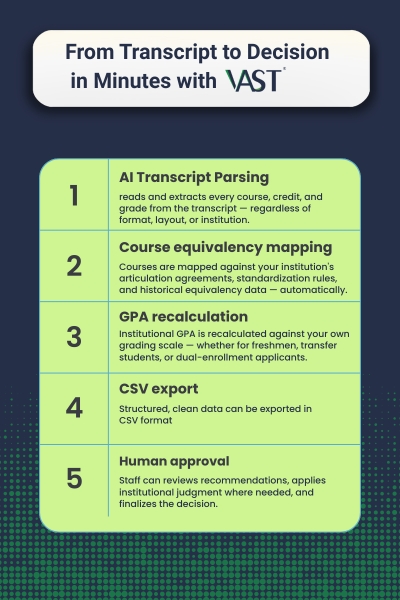
From the moment a transcript is received to the moment a student gets their decision, the entire process can take minutes.
That speed isn't just an operational win. It's a strategic one. Students who get fast, clear, and transparent decisions commit. And institutions that move quickly don't just fill seats; they build a reputation for respecting the people walking through their doors.
With VAST, the waiting game is over. Not just for students but for your team too.