
How Modern AI Transcript Evaluation Tools Can Fit into Your Existing Systems
Every admissions cycle, thousands of transcripts land on the desks of enrollment teams across the country. Each one needs to be read, interpreted, and entered into a system manually. It is time-consuming, inconsistent, and quietly expensive. If you multiply it across a full applicant pool (freshman and transfer alike) and the cumulative cost in staff hours, processing delays, and evaluation errors becomes very hard to ignore.
AI-powered transcript evaluation tools exist to fix exactly that. They can extract, interpret, and structure complex academic data in seconds, cutting processing time drastically and bringing consistency to a workflow that has historically relied on individual judgment.
But adopting new technology is only half the equation. The other half is making sure it actually works with the systems you already use. And this is where many institutions hesitate.
As institutions evaluate AI transcript evaluation platforms, one of the key considerations is how the solution will fit into their existing technology ecosystem. IT teams focus on data security, system compatibility, and governance, while admissions and registrar teams want to ensure that existing workflows remain efficient. Institutional leadership, meanwhile, looks for an implementation process that is predictable, minimizes disruption, and delivers value within a reasonable timeframe.
These concerns are not unfounded. Poorly integrated tools create data silos, require manual workarounds, and can end up adding work rather than reducing it. The fear is not irrational; it is the product of past experience with technology rollouts that were overpromised and underdelivered.
The good news is that modern AI transcript evaluation platforms are built with integration in mind. Whether your institution relies on SFTP-based file transfers or prefers the real-time responsiveness of an API connection, the right platform meets you where you are without requiring your IT team to rebuild what is already working.
This post breaks down how both integration approaches work, and what each one means for your existing infrastructure. Keep reading to know more.
Understanding the Integration Backbone: SFTP vs. API
Before diving into which method fits your institution, let us help you understand what each one actually does in a real admissions environment.
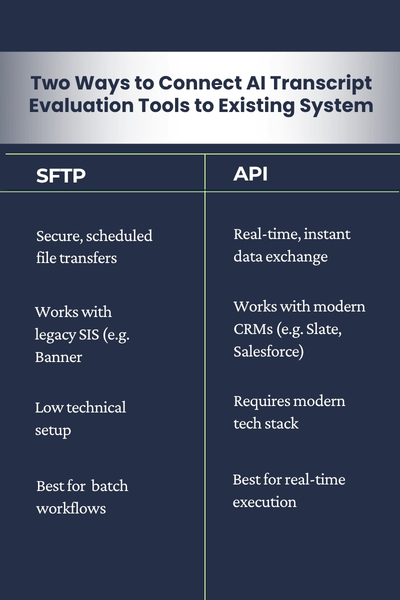
Think of SFTP and API as two different ways of moving data between systems. Both get the job done, but they behave very differently, and those differences matter depending on how your campus operates and what your IT team can support.
➤ SFTP (Secure File Transfer Protocol): The Reliable Batch Processor
SFTP is a time-tested, highly secure protocol for moving files over an encrypted data stream. On most campuses, it is already the default method for scheduled data transfers; which makes it a natural starting point for AI transcript integration.
Here is how it works in practice:
Transcripts are collected either by your admissions team or a third-party platform and pushed to a secure SFTP folder on a set schedule. The AI transcript engine picks them up, processes them, and returns structured data files to an outbound folder. Your SIS or CRM pulls those files and updates student records automatically.
Why institutions choose SFTP:
- Low technical barrier - Most legacy SIS platforms like Banner are already built to handle flat-file SFTP transfers. There is often very little new infrastructure to build.
- High security - Data moves in bulk through a single, tightly controlled pipeline, making it straightforward to audit and monitor.
➤ API (Application Programming Interface): The Real-Time Connector
If SFTP is a scheduled delivery, an API is a live conversation. It allows two software systems to exchange data instantly; no waiting for a batch, no manual handoffs.
Here is how it works in practice:
The moment a student uploads their transcript to your admissions portal, the CRM triggers an API call and sends the document directly to the AI transcript tool. Within seconds, the AI processes it and returns structured data back to your CRM or SIS, automatically updating the student's profile in real time.
Why institutions choose API:
- Real-time execution - Transcripts are processed and visible to your admissions staff almost immediately, keeping workflows moving without delay.
- Better applicant experience - Live portals can surface credit evaluations to students as they happen, reducing the back-and-forth that slows down enrollment decisions.
Choosing the Right Fit for Your Campus Workflow
The right integration method comes down to two things: your current technology stack and how your admissions team actually operates day to day.
Go with SFTP if your institution runs a legacy or on-premise SIS that is difficult to modify. If next-day data availability works for your team and you prefer a predictable, hands-off routine, SFTP delivers stability without disruption.
Go with API if you are running a modern cloud CRM like Salesforce or Slate and speed is the priority. If an admissions counselor needs to pull up a processed transcript during a live advising call, real-time integration is not a nice-to-have; it is a requirement.
Either way, the goal is the same: clean, structured, actionable academic data flowing into your core systems without anyone entering it by hand.
Introducing VAST: Next-Gen AI Transcript Evaluation Platform
VAST is an AI-driven platform that automates transcript processing, course extraction, and transfer credit evaluation for higher education institutions. By eliminating manual data entry, VAST significantly reduces administrative burdens on registrar teams while accelerating turnaround times and improving decision accuracy.
How VAST Seamlessly Fits into Your Existing System
You do not need to replace your existing system to leverage VAST. Designed to fit perfectly within higher education's diverse IT landscapes, VAST integrates directly with your existing SIS or CRM (such as Slate, Salesforce, Banner, or Workday).
Whether your IT team prefers the structured, scheduled reliability of SFTP batch processing or the ultra-fast, real-time automation of modern APIs, VAST accommodates your preferred delivery method. By sitting quietly in the background and feeding intelligent, recalculated data straight into the student records you use every day, VAST turns hours of manual transcript auditing into an instantaneous, automated workflow.