
Manual Transcript Evaluation Is Costing You More Than Staff Hours
Ask any registrar what eats up the most time during enrollment season. Nine times out of ten, the answer is the same: transcripts. Reviewing them. Interpreting them. Matching courses. Chasing down missing documents. It never stops, and at most institutions, every single step is still done manually.
Most institutions treat this as a staffing problem. More hands, lighter load. But that thinking misses the bigger picture. The true cost of manual transcript evaluation isn't just time; it's what that time is costing you in enrollment outcomes, operational capacity, and institutional growth.
Let’s dig deeper into what manual transcript evaluation actually costs you.
The Obvious Cost: Time
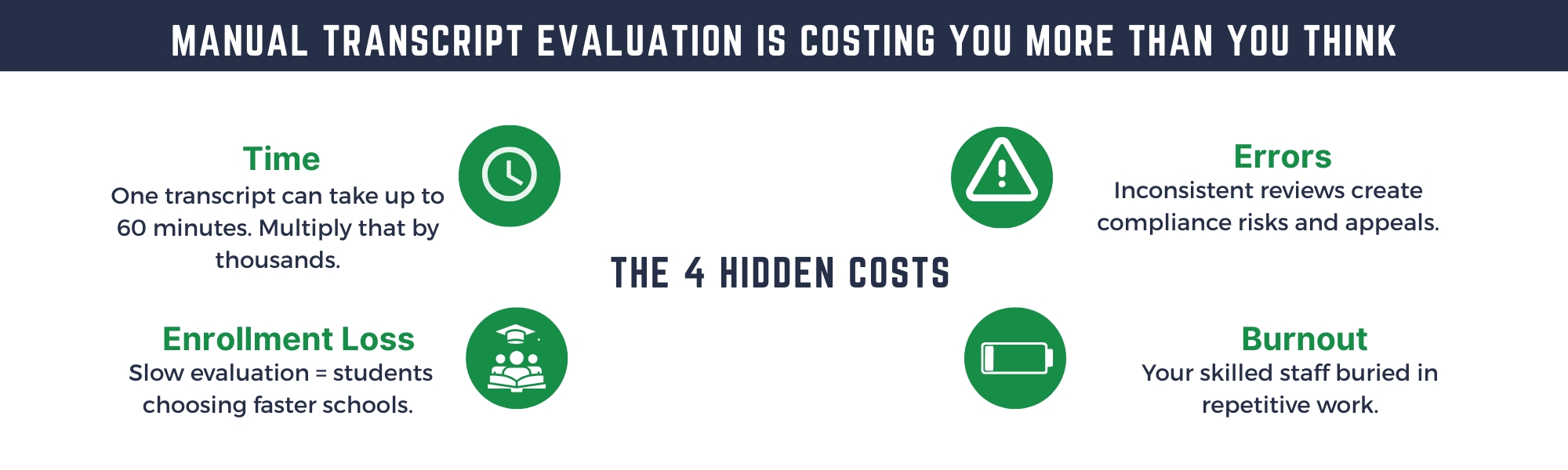
Let's start with what everyone already knows: manual transcript evaluation is slow. One transcript can take anywhere from a few minutes to over an hour, depending on where it came from, how many courses are listed, how the grading system works, and whether your team has seen that institution before.
Now multiply that time across hundreds, or thousands of applicants in a single cycle. Freshmen submitting high school transcripts. Transfer students bringing credits from two or three prior institutions. It adds fast, and it lands almost entirely on your staff.
At peak enrollment, that workload creates backlogs. And backlogs don't just sit there; they create delays that ripple through your entire enrollment funnel, with real financial consequences.
The Cost No One's Measuring: Enrollment Attrition
Most institutions have no idea how many students they lose during the evaluation window. But it's happening.
Today's prospective students are comparing options in real time. They're watching which college responds faster, communicates more clearly, and gives them confidence sooner. When transcript evaluation takes weeks, students sit in a waiting game, unsure about credit transfers, degree timelines, and course placement. That uncertainty has a cost.
Some students will hold on. Many won't. They'll go with the institution that had answers when yours didn't. And because nobody's tracking evaluation turnaround as an enrollment metric, the loss stays invisible.
The Hidden Cost: Errors and Inconsistency
Here's something that doesn't get talked about enough: manual transcript evaluation is inconsistent by nature. Two reviewers, same transcript, different outcomes. GPA recalculations are done differently depending on who's handling them. AP credits, international transcripts, all interpreted differently across departments, sometimes within the same institution.
The downstream impact is significant. Credit errors can affect financial aid eligibility, academic standing, and program admission. They generate appeals that consume staff time. They create compliance risks. And because they typically surface after a student has already enrolled, they're harder to fix and more damaging when they do.
Your Team's Time Is Worth More Than This
Here's the dimension that gets overlooked most: your people. Registrar staff are skilled professionals. They're hard to hire and harder to replace. But when their days are dominated by repetitive, high-volume document review, you're not using that expertise; you're burying it. The work that actually needs their judgment, exception cases, student advising, policy decisions, cross-department coordination; gets squeezed into whatever time is left.
Burnout follows. It's already common in registrar offices, particularly where enrollment is climbing, but staffing hasn't kept pace. The transcript backlog is rarely the only cause, but it's almost always part of the story.
What Happens When You Automate Transcript Evaluation
Institutions that have automated transcript evaluation report the same outcomes: faster turnaround, fewer errors, more consistency, and staff with capacity to spare. Students get clarity earlier in the process. Enrollment teams move with more confidence. And registrar professionals finally have room to focus on the work that requires their expertise.
This isn't about replacing people. Complex cases, exceptions, and edge scenarios still need experienced hands. The goal is simpler, stop asking your best people to spend their days on work which a system can do better and faster. Free them up for everything else.
How VAST Addresses This
VAST was built for exactly this problem. It automates the heavy lifting of transcript evaluation: course matching, credit equivalency mapping, and GPA recalculation; for both freshmen and transfer applicants. Exceptions get flagged for human review. Everything else moves through automatically, accurately, and fast.
VAST integrates directly with the platforms your team already works in, so there's no workflow overhaul, just a smarter process inside the one you already have. The result is faster turnaround, fewer errors, and an evaluation process that grows with your enrollment volume without demanding more from your staff.
If your team is spending more time on transcripts than on the students behind them, it's time to look at a better way. Schedule a demo and see what VAST can do for your institution.